
Overtime Calculation in UAE 2026
You stayed late at work all month, but your payslip does not seem to show the extra hours fairly. So you start to wonder if your overtime pay is even correct. You are right to check, because many employees in the UAE are underpaid for overtime, often because their employer uses the wrong rate or the wrong salary base.
This guide clears it all up. UAE Labour Law sets fixed overtime rates, and once you know them, you can check your own pay in minutes. Below, we explain what counts as overtime, the exact rates for day, night, and holiday work, a simple formula with worked examples, and what to do if your employer does not pay you correctly. By the end, you will know precisely what you are owed for every extra hour.
How Overtime Pay Works in the UAE
If you work beyond your normal hours in the UAE, your employer must pay you extra on your basic salary. Here are the rates set by UAE Labour Law:
The formula is simple: find your hourly rate by dividing your basic salary by 30, then by 8. Multiply that by the overtime rate and the number of overtime hours. Overtime is always based on your basic salary only, never your allowances, and your employer cannot make you work more than 2 extra hours a day.
What is Overtime According to UAE Labour Law?
Overtime is any time you work beyond your normal legal hours. Under Article 19 of Federal Decree-Law No. 33 of 2021, the standard limit is 8 hours a day or 48 hours a week. So any hours you put in past that count as overtime, and your employer must pay you extra for them.
But here is the catch: not every extra hour qualifies. The law sets clear rules on who is eligible, which hours count, and how much you must be paid. For example, some senior roles are exempt, and the rate changes depending on whether you work in the daytime, at night, or on a rest day. The rest of this guide breaks each of these down, so you know exactly where you stand.
UAE Overtime Rates (2026)
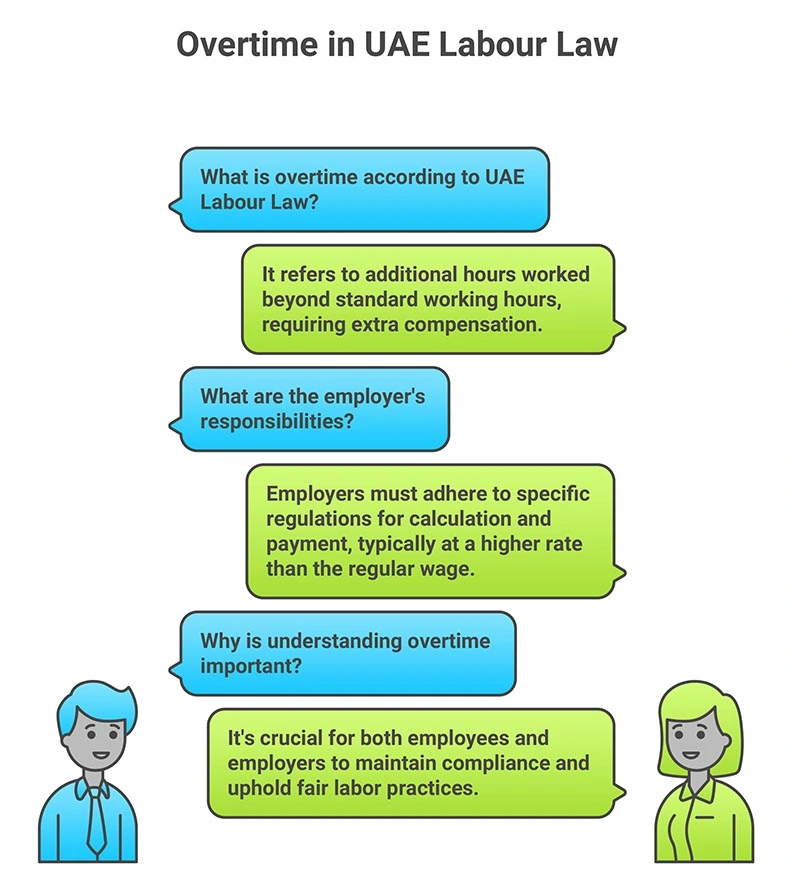
Your overtime rate depends on when you work the extra hours. UAE Labour Law sets three clear rates, and each one is built on your basic hourly wage. Here is how each works.
Normal Overtime (125%)
This applies to extra hours you work during the daytime, outside your normal 8-hour shift. You earn your hourly rate plus 25%, so your overtime rate is 125% of your normal pay. This is the most common type of overtime for office and daytime staff.
Night Overtime (150%)
If your extra hours fall between 10 PM and 4 AM, you earn a higher rate. Night overtime pays your hourly rate plus 50%, which is 150% of your normal pay. The law adds this extra because night work is harder on your health and routine.
Rest Day and Public Holiday (150%)
If you work on your weekly rest day or a public holiday, you earn 150% of your hourly rate. Instead of the extra pay, your employer can give you a substitute day off, but if you take the day off and still work the hours, you are owed the premium. So you never lose out for giving up your rest day.
Who Is Eligible for Overtime in the UAE?
Not everyone in the UAE can claim overtime pay. The law protects most workers, but it exempts a few senior roles. Here is who qualifies and who does not.
You are usually eligible if:
You are usually exempt if:
One important point: the exemption depends on your actual duties, not just your job title. So if your title says “manager” but you have no supervisory power, you may still be entitled to overtime. Some groups, like domestic workers, follow their own separate rules. When in doubt, check your employment contract and your labour classification, or raise it with MOHRE.
How to Calculate Overtime in the UAE (Formula and Examples)
Working out your overtime is simple once you know the two steps: find your hourly rate, then apply the right overtime rate. Let us walk through both.
The Hourly Rate Formula
Your overtime is based on your basic salary only, so leave out housing, transport, and other allowances. Here is the formula:
Basic Formula For Overtime Calculation In UAE
Hourly rate | Basic monthly salary ÷ 30 days ÷ 8 hours |
Overtime pay | Hourly rate × Overtime rate × Overtime hours |
The overtime rate is 1.25 for normal hours, and 1.5 for night, rest day, or public holiday hours.
Worked Examples
Example 1 — Normal daytime overtime. Say your basic salary is AED 6,000 and you work 10 extra daytime hours.
Hourly rate | 6,000 ÷ 30 ÷ 8 = AED 25 |
Overtime pay | 25 × 1.25 × 10 = AED 312.50 |
Example 2 — Night overtime. Say your basic salary is AED 8,000 and you work 5 hours between 10 PM and 4 AM.
Hourly rate | 8,000 ÷ 30 ÷ 8 = AED 33.33 |
Overtime pay | 33.33 × 1.5 × 5 = AED 250 |
Example 3 — Mixed. Say your basic salary is AED 10,000, with 15 normal hours plus 8 night hours.
Hourly rate | 10,000 ÷ 30 ÷ 8 = AED 41.67 |
Normal | 41.67 × 1.25 × 15 = AED 781.25 |
Night | 41.67 × 1.5 × 8 = AED 500 |
Total | AED 1,281.25 |
The calculator above does all of this for you in seconds, so you can check your payslip without any manual maths.
Overtime During Ramadan in UAE
During Ramadan, working hours drop by two hours a day for all employees, whether or not they are fasting. So your standard shift becomes 6 hours a day instead of 8. This shorter day is a legal right, not a favour, and it applies across the private sector.
This matters for your overtime. Since your normal limit is now 6 hours, any work beyond that counts as overtime and earns the same rates as usual, 125% for daytime and 150% for night hours. So if you work a full 8-hour day during Ramadan, those extra 2 hours should be paid as overtime.
One point to confirm with your employer: some companies apply the 2-hour reduction to everyone, while a few interpret it more narrowly. The law itself sets the reduced hours, so if your employer keeps you on a full 8-hour day with no overtime, you have grounds to raise it with MOHRE.
Overtime Caps and Limits
Overtime is not unlimited. UAE Labour Law puts clear limits on how much extra work your employer can ask of you, to protect your health and rest.
If your employer regularly pushes you past these limits, or asks for long overtime without proper pay, that breaks the law. So keep a record of your extra hours, and raise any pattern of excess overtime with MOHRE.
Common Overtime Mistakes to Avoid
A few common errors cause employees to lose overtime money, or accept a wrong figure. Watch out for these:
Avoid these five, and you will always know your true overtime pay, and spot any underpayment quickly.
What If Your Employer Does Not Pay Overtime?
If your employer refuses to pay your overtime, or pays the wrong rate, you have a clear way to claim what you are owed. Overtime is your legal right, not a favour, so do not let it slide.
Follow these steps in order:
Your employer cannot punish you for making a fair claim. So if you are owed overtime, use the calculator above to work out the exact amount, then raise it with confidence.
Conclusion
Overtime pay in the UAE is simpler than it looks once you know the rules. You earn 125% for normal daytime hours, 150% for night work between 10 PM and 4 AM, and 150% or a day off for rest day and public holiday work. It is always based on your basic salary, never your allowances, and your employer cannot push you past 2 hours a day or 144 hours over three weeks.
So do not leave your extra hours to guesswork. Use the calculator above to work out exactly what you are owed, check it against your payslip, and raise any gap with your employer or MOHRE. When you know the numbers, no one can shortchange you for the extra time you put in.